Renter Friendly Wallpaper: The Complete 2026 Guide
A practical guide to renter friendly wallpaper: which removable brands peel off clean, what they cost, and how to install without losing a deposit.

Disclosure:Some links on RenterFriendly.com are affiliate links. If you buy through them, we may earn a small commission at no extra cost to you. We only feature products we’d use in our own rentals. See our transparency policy.
Quick Answer
Yes, peel and stick wallpaper is renter friendly when applied to smooth, fully cured painted drywall, where quality brands lift off cleanly in 20 to 60 minutes with no residue. The biggest risks are textured walls (orange peel, knockdown), fresh paint that has not cured for 3 to 4 weeks, and low-VOC or stain-resistant paints, all of which can cause the adhesive to pull paint at removal. Always order a $2 to $8 sample, test it on your actual wall for 3 to 7 days, and check your lease for any wall covering restrictions before committing.
Overview
Renter friendly wallpaper solves the problem that almost every renter runs into. You want your home to feel like yours, but your landlord doesn't allow painting, patching, or drilling, or else you'll lose your deposit. If you're a renter, you've probably been heard it time and time again, to simply "deal with it". Just put up with the white walls and hang a few pictures. But that solution usually isn't ideal, because it makes you feel like you're living in someone else's home, not yours. So, what can help you make your home feel like yours, but also not put you at risk of losing your depost? The solution - renter friendly wallpaper.
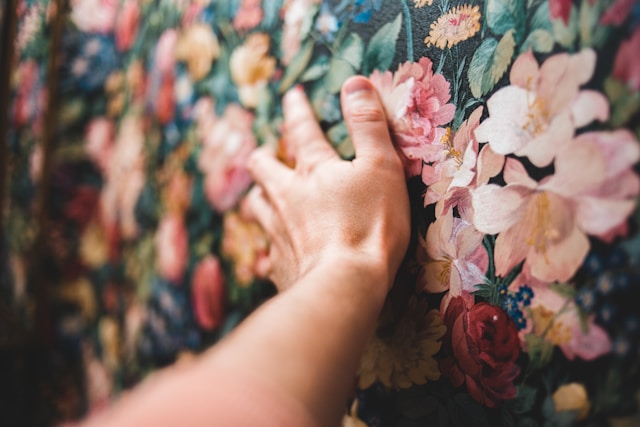
The category of "renter friendly wallpaper" has gained popularity for a reason. Searches for peel and stick products now run around 1.6 million a month and have grown roughly 60 percent over the past year, as renters and apartment dwellers look for temporary design and decor options. And the amount of available wallpaper options has kept pace. There are countless removable wallpaper options to choose from and include color-drenching solids, bold floral murals, eccentric boho patterns, dark and moody woods, and even custom designed patterns from your favorite designers.
The catch, though, is that peel-and-stick wallpaper doesn't always guarantee that it's always cleanly removable. The same panel that peels off a smooth, cured wall in twenty minutes can pull paint off a freshly painted or textured one. So the product you choose, and the wall you put it on, collectively determines whether you get your deposit back. The rest of this guide covers how to pick, install, and remove renter friendly wallpaper without a surprise charge at move-out. For curated, renter-tested picks by room, our wallpaper ideas hub is a good place to start.
Step-by-Step
- 1Measure your wall and add a trim allowanceMeasure width times height, then add about 6 inches on each dimension for trimming and round up to full rolls or panels. A standard roll covers roughly 28 to 30 square feet. Buy one extra roll in the same lot number so a mistake does not leave you with a mismatched batch later.
- 2Identify your wall surface and paintSmooth, flat painted drywall is ideal. Textured walls (orange peel, knockdown) and fresh paint are the two biggest failure points. Fresh paint needs about 3 to 4 weeks to cure before anything sticks safely, and the low-VOC or stain-resistant paints common in newer rentals can resist adhesion entirely.
- 3Order samples before you commitMost brands sell samples for $2 to $8. Order them, tape them to the actual wall, and leave them a few days. You are checking two things: how the color reads in your light, and whether the adhesive grabs your specific surface.
- 4Clean and prep the wallWipe the wall with 70 percent isopropyl alcohol to remove dust and oils, then let it dry fully. Skip sprays and cleaners that leave a residue, since that residue is what causes early peeling at the edges.
- 5Start from a corner with a levelDo not trust the ceiling line. Most rental ceilings and corners are not square, so a panel aligned to the ceiling drifts crooked across the wall. Draw a plumb line with a level and align your first panel to that instead.
- 6Peel a few feet at a time and smooth as you goExpose 3 to 4 feet of backing at a time, press from the center outward, and push air bubbles to the edges with a squeegee or an old gift card. Working in sections keeps the adhesive from folding onto itself.
- 7Match the seams and trimLine up the pattern, then butt or slightly overlap the seams according to the brand instructions. Trim the excess at the ceiling and baseboard with a sharp utility blade, changing blades often so the cuts stay clean.
- 8Plan your removal nowRemoval takes about 20 to 60 minutes for an accent wall. Peel slowly at a low angle, and warm any stubborn corners with a hairdryer to soften the adhesive. If you might reuse the panels, save the backing paper so you can re-roll them.
Renter Considerations
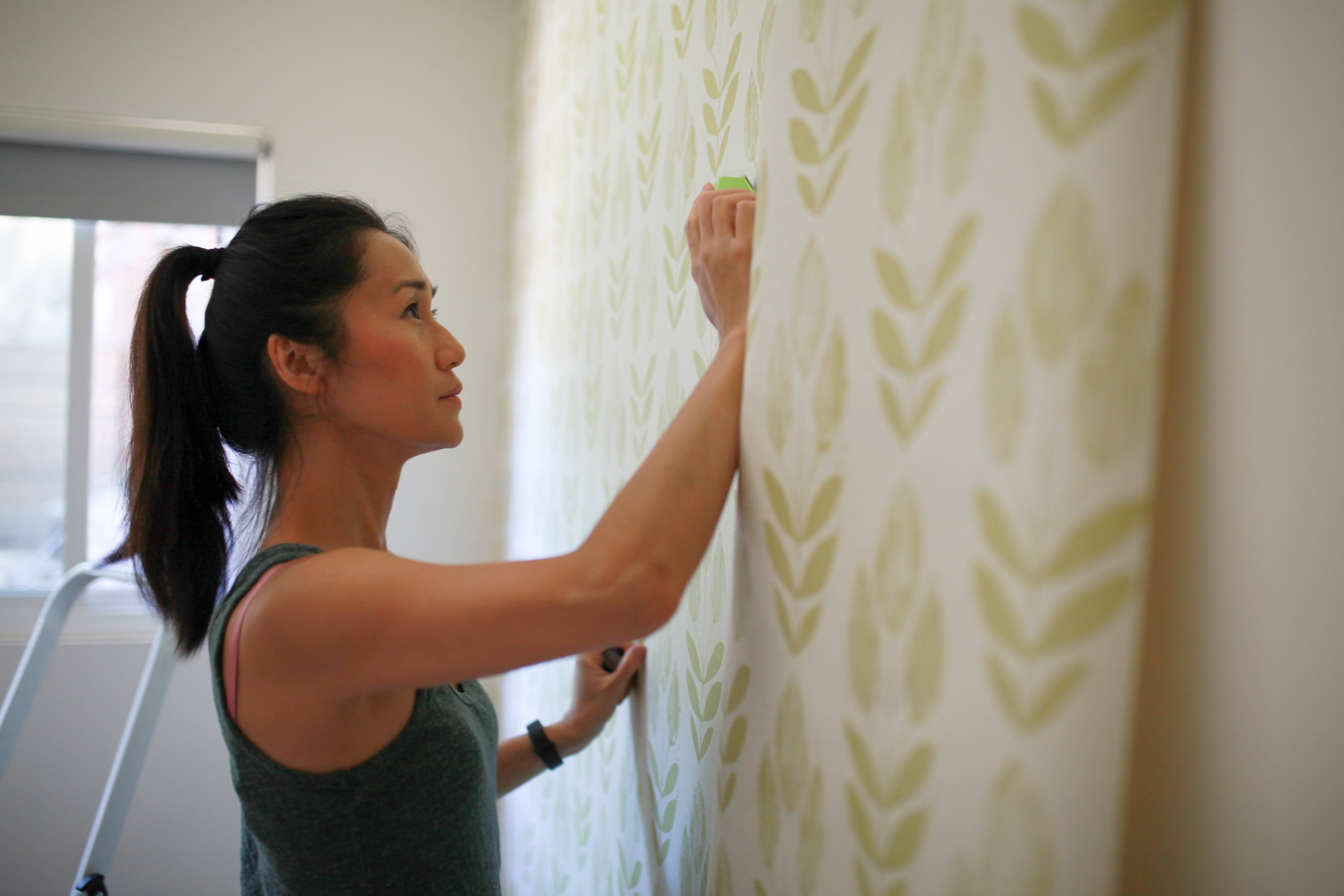
Deposit safety: The biggest risk is not the wallpaper. It's actually the wall under it. On smooth, fully cured paint, quality peel and stick lifts off clean. On fresh paint, glossy enamel, or textured drywall, the adhesive can take paint or topcoat with it. Photograph the wall before and after so you have a record.
Enjoying this? Get more renter-safe ideas
Join the list for damage-free upgrades and our free Renter’s Decor Toolkit.
No spam. Unsubscribe anytime.
Removability: Plan on 20 to 60 minutes to strip an accent wall. Low and slow is the rule, and a hairdryer on the corners turns a stubborn panel into an easy one.
Surface compatibility: Smooth, clean, flat walls are the safe bet. Orange peel and knockdown textures are where most renters get burned, though a few brands are made specifically for them.
Lease concerns: Most leases say nothing about removable wallpaper, but some ban "wall coverings" outright. Read the alterations clause before you order anything.
Landlord approval triggers: If your lease is strict, or you are covering a large area or an unusual surface like brick, paneling, or tile, send a short email with a photo of the product and its removable rating. A quick paper trail protects you.
Test in a small spot first: Stick a sample in an inconspicuous corner and leave it 3 to 7 days. If it lifts cleanly with no residue or paint transfer, you are clear to do the full wall.
Cost, Tools, and Materials
Item | Typical cost |
|---|---|
Budget vinyl peel-and-stick (per roll) | $20 to $40 |
Mid-range fabric or woven (per roll or panel) | $35 to $60 |
Premium designer (per panel or roll) | $45 to $258 |
Samples or swatches | $2 to $8 each |
Smoothing tool or squeegee | $5 to $12 |
Level | $8 to $20 |
Utility knife and spare blades | $5 to $15 |
Isopropyl alcohol for wall prep | $4 to $8 |
Tools you need: a tape measure, a level, a smoothing tool or squeegee, a sharp utility knife with extra blades, and a step stool for the top of the wall.
Materials you need: your wallpaper rolls or panels (plus one extra in the same lot), 70 percent isopropyl alcohol, a clean cloth, and painter's tape to hold panels while you align them.
Pros and Cons
Pros | Cons |
|---|---|
No paste, glue, or special tools | Struggles on textured walls unless specially made |
Fully reversible, deposit-safe on smooth walls | Can pull fresh or low-VOC paint |
Fast, an accent wall in 1 to 3 hours | Premium designer rolls add up quickly |
Huge range of patterns and colors | Seams and bubbles take patience |
Repositionable during installation | Not ideal for high-humidity rooms unless rated for it |
The Best Renter Friendly Wallpaper Brands for 2026, Compared
There is no single best renter friendly wallpaper brand, only the right one for your wall, your budget, and your style. The eight below are the names that come up most often for renters, sorted roughly from budget to premium. Prices move, so confirm current pricing before you buy.
Brand | Material | Typical price | Textured walls? | Best for |
|---|---|---|---|---|
Vinyl | ~$20 to $40 per roll | No, smooth only | Budget, kids rooms, big-box availability | |
Vinyl and linen texture | Mid, $2 samples | By design, check first | On-trend looks, 1,400-plus designs | |
Tempaper | Vinyl and faux grasscloth | ~$36 to $60 per roll | No, smooth only | Designer styles sold at major retailers |
Spoonflower | Woven fabric, matte | From ~$28 per small panel | Smooth recommended | Custom and independent-artist designs |
Livette's | Non-woven and polyester, PVC-free | Mid-premium | Smooth, prep needed | Eco-conscious, low-tack option for delicate walls |
Loomwell | Fabric-textured | Mid, samples ~$8 | Yes, including orange peel | Renters with textured walls |
Chasing Paper | Poly-woven, fabric-like | ~$45 per 2-by-4-foot panel | Smooth, tested clean on bare walls | Quality first, easiest clean removal |
Vinyl, fabric, grasscloth | Premium, rolls up to ~$258 | No, smooth and cured only | High-end designer statement |
RoomMates is the budget workhorse, sold almost everywhere, including Amazon, Target, Walmart, Lowe's, and Home Depot, for roughly $20 to $40 a roll. It is a removable vinyl that is repositionable and leaves no residue on smooth walls, and it is made in the USA. Pick it for low cost, wide availability, and licensed or kids prints.
Tempaper calls itself the original peel and stick brand and is widely carried at major retailers. Rolls run about $36 to $60 and come in vinyl plus faux grasscloth textures, with designer collaborations. It is repositionable and offers moisture-resistant lines for bathrooms, but the brand says it is not recommended for textured walls.
Wall Blush is the trend-driven option, with more than 1,400 peel and stick designs aimed squarely at renters and $2 samples. The catalog leans bold and current, which makes it a good fit if you want a viral look without a long-term commitment.
Spoonflower is the customization pick, a marketplace of millions of independent artists where you can order a swatch for about $8 or upload your own art. Its woven-textured matte material is repositionable, but because everything is printed to order, shipping takes longer. Pricing starts around $28 for a small panel.
Livette's has specialized in removable wallpaper for over a decade and offers two PVC-free, low-VOC materials, a polyester textile and a non-woven eco matte. The brand specifically recommends its lower-tack Eco Matte for rentals because it is gentler on walls, which makes it a smart choice for older or delicate paint.
Loomwell is the answer to the most common renter complaint. Its fabric-textured peel and stick is made to adhere to textured walls, including orange peel, where most brands fail. Designs are artist-made and it is USA-made, with samples around $8, and it is worth ordering one even though the material is texture-rated.
Chasing Paper is the quality-first choice. It sells in roughly 2-by-4-foot panels around $45, and CNN Underscored's testers rated its poly-woven, fabric-like material the easiest to apply and remove on bare walls. Choose it if clean removal is your top priority.
Wallshoppe is the premium designer end, made in Los Angeles with peel and stick panels, traditional rolls, and grasscloth, plus name collaborations. Expect higher prices, with traditional rolls running around $258. The brand is clear that it will not adhere to textured, stucco, or concrete walls, or to low-VOC and stain-resistant paints.
Common Mistakes

Applying to textured walls without checking
Orange peel and knockdown textures keep most peel and stick from bonding, so it lifts at the corners within days. Confirm your brand is rated for texture, or stick to smooth walls.
Skipping the sample test
A $2 to $8 sample tells you how the adhesive behaves on your exact wall and how the color reads in your light. Skipping it is how people end up with $200 of wallpaper that will not stay up.
Wallpapering over fresh paint
New paint needs about 3 to 4 weeks to cure. Apply sooner and the adhesive bonds to uncured paint, which then peels off together at move-out.
Not cleaning the wall first
Dust and oils break the bond. A quick wipe with 70 percent isopropyl alcohol, followed by full drying, prevents most early peeling.
Ignoring the pattern repeat when measuring
Large repeats waste material. Measure, add a 6-inch trim allowance, and account for the repeat so you do not run short in the middle of a wall.
Leaving cheap vinyl up for years
Budget vinyl that goes up fine can bake onto the wall after a few years and pull paint on removal. For a long-term spot, choose a higher-quality woven or fabric product.
Other Renter Friendly Wallpaper Options to Consider
peel and stick wallpaper for renters: This is the most popular type of removable wallpaper, with a self-adhesive backing you press straight onto the wall. It stays repositionable while you work, so you can lift and realign a panel without starting over, which makes it forgiving for beginners.
removable wallpaper: Removable wallpaper is the umbrella term, and it covers both peel and stick and pre-pasted (water-activated) styles. Both are designed to come off without damage, but peel and stick is faster and less messy, while pre-pasted often costs a little less per square foot.
apartment friendly wallpaper: In an apartment you are usually working with shared walls, builder-grade flat paint, and a strict lease. Lower-tack products and smaller accent areas, like one wall, a closet, or a nook, cut both the cost and the removal risk.
is wallpaper renter friendly: Traditional pasted wallpaper is not renter friendly, but removable peel and stick is, as long as you use it on smooth, cured walls and remove it carefully. The product type and the wall surface matter far more than the wallpaper category itself.
Final Thoughts

The DIY renters who manage to successfully keep their deposit are not the ones who buy the most expensive wallpaper. They are the ones who matched the product to their wall and tested it first. A smooth wall with cured paint can handle almost anything on this list. However, a textured or freshly painted wall needs a specific product and a little patience, or it needs to wait.
If you take one step this week, make it this: pick two brands mentioned in this post, order one sample of each (plan on roughly $4 to $16 total), and tape them to the actual wall you want to cover. Leave them up for a full seven days, then peel them off and look for residue or paint transfer. That single test, for about the price of a cup of coffee, is what stands between a rental that finally feels like yours and a deposit dispute you did not see coming.
Sources & References
- [1] CNN Underscored: Best Peel and Stick Wallpaper Tested - CNN Underscored
- [2] Tempaper: About and Surface Recommendations - Tempaper
- [3] Loomwell: Textured Wall Peel and Stick Wallpaper - Loomwell Home Goods
- [4] Wallshoppe: Surface Compatibility FAQ - Wallshoppe
- [5] Livette's Wallpaper: Eco Matte for Rentals - Livette's Wallpaper


